No Rest for the Wicked

In the end, we are who we are. The best we can hope for after we’re gone is that someone will think enough of us to to render a kind and fair account of our memory.

The thing is, in death as in life, you tend to do unto others the way they did unto you, and, well, long story short, singer-songwriter Warren Zevon, who died from mesothelioma in 2003 at the age of 56, wasn’t always a very nice person.

Zevon, like his songs, was often acerbically funny and witty and generous; in music and in life he possessed the ability to locate poetry in the commonplace. But he also epitomized Toulouse-Lautrec’s dictum that “One should never confuse the artist with the art.” Zevon the man  had difficulty seeing beyond his own often petty desires and, as a result, left scores of hurt friends and family in his wake. Which, when it comes to the more than 130 songs he wrote and recorded in his 34-year recording career, is neither here nor there.

In a genre that begets imitation and champions crass commercialism, Zevon was an original. Reviewing Zevon’s eponymous album back in 1976, Paul Nelson called forth a disparate roster of stellar artists to herald Zevon’s arrival: “he is a talent who can be mentioned in the same sentence with Bob Dylan, Jackson Browne, Randy Newman, Neil Young, Leonard Cohen, and a mere handful of others no apologies necessary.”

All of which brings us, over 30 years later, to the new book I’ll Sleep When I’m Dead: The Dirty Life and Times of Warren Zevon. Written by Zevon’s ex-wife Crystal Zevon, the book provides a compelling oral history of a man who was as troubled as he was talented. Detailing the years before, during, and after Zevon’s battle with alcoholism, the result is an artfully rendered casebook study of an addictive personality and, because Zevon portrays herself as honestly as she does her ex-husband, a codependent relationship.

Less than halfway through the book, photographer and art director Jimmy Wachtel, commenting on Zevon’s newfound sobriety, gets right to the heart of the matter: “To be honest, he was the same asshole, drunk or sober, so there wasn’t that much difference except he didn’t repeat himself as much.”

For those of us who didn’t know Warren Zevon personally, it remains the work that matters, for which he’ll be remembered. For those who did know him, who have to sift through the memories and hang onto the ones that made Zevon special and kept him in their lives and their hearts, it’s a bit more difficult.

*


I’ll Sleep When I’m Dead: The Dirty Life and Times of Warren Zevon
is due out from HarperCollins on May 1st. In the meantime, Crystal Zevon is posting updates about personal appearances and other related events — as well as material about Warren Zevon that doesn’t appear in the book — over at her website.

Things that happened in the last week:My sister …

Things that happened in the last week:

  • My sister had a birthday. Happy birthday, Jenn!;
  • She called from Brazil, where she is visiting her husband’s family;
  • SXSW rolled through Austin, bringing many out-of-town friends;
  • I ate bbq twice with some of these out-of-town friends, including the ultra-cool Maud Newton and the mysterious man known only as Mr. Maud;
  • My parents visited and we played Cities and Knights of Catan not once, but twice;
  • My in-laws visited and gave/sold us a brand-new Prius;
  • We spent time with in-town friends who we don’t see nearly as often as we should;
  • We watched Borat;
  • I worked on the book.

I think that’s it. All of these deserve more words, but my words are all committed to other projects at the moment.

THAT ELUSIVE CHURCH MICE 45

One of the more wacked records I’ve been turned onto in recent years is this raspy, tuneless 1965 single from a Rochester, NY act called THE CHURCH MICE. I first heard of the record when it was pictured and briefly discussed in Johan Kugelberg’s Ugly Things feature on “primitive shit rockâ€Â (which I in turn wrote about here). A little research on the web brings me IT’S GREAT SHAKES which will tell you far more about the record – and why it’s important that you hear it – than I ever could. Finally, even crazy old Julian Cope got into the act and wrote up a piece on the ‘Mice and about the even more bent offerings from Armand Schaubroeck that followed this release. Schaubroeck is a real cult figure that I haven’t quite cottoned to just yet, but this 45 certainly leads me merrily in that direction. Easily one of the 1960s’ strangest pre-punk records.

Download CHURCH MICE – “Babe, We’re Not Part of Societyâ€Â (A-side of 45)
Download CHURCH MICE – “College Psychology on Loveâ€Â (B-side of 45)

The Magic Question

So today’s thinking exercise was going to a SXSW panel called Covering Music In New Media, moderated by my pal Jason Gross. The participants were Michael Azerrad from eMusic, Erik Flannigan of AOL, Amy Phillips of Pitchfork Media, mighty Mark Pucci (one of my favorite publicists) and someone I think was Nick Baily of Shorefire Media, another great publicist. The panel description ended with this sentence:

“Without a reliable and financially sustainable model for online media, what is a rock critic to do?”

Well, yeah.

Naturally, all the folks with dogs in the online media fight — Azerrad, Flannigan, and Phillips — sought to assure everyone that their online publications were as viable as the print ones, as opposed to the many unreliable bloggers and fan-sites. The talked about coping with the flood of product, the fight to maintain some sort of credibility in the face of illegal uploads and rumor-mongering. They said that discussing which online sites will eventually work and which won’t is like asking if Rolling Stone would survive in 1973 — a good point.

What they did not discuss is what every single writer I’ve talked to here has been talking about: there is no paying work. Anywhere. Rumors of magazines going broke abounded, and the most-spoken sentence was “Man, I can’t remember when it was ever this bad.” When I’d respond that I couldn’t, either, I got a shocked look, since I was writing about music something like 20 years before any of these other folks came on the scene. Nobody is making a living any more. Nice to have spent your life learning a trade you can no longer practice and can’t make a living at, eh?

“Great audience at this,” commented the irrepressable Jim Fouratt, who’s been in this business even longer than I have (well, by a year or two). “Half of ’em are dinosaurs and half of ’em are 18-year-olds.” And what we old folks had in common with our spiritual grandchildren was that neither of us can figure out how to make a living doing what we want to do. What we did not have in common with them was that once, we actually did, even if it was never a good one.

In a way, I’m lucky. Writing about art and culture for the Wall Street Journal for all that while liberated me from rock criticism, and I’m less and less interested in writing about (and listening to) music these days. Rock criticism has always paid less than any other cultural commentary, and that hasn’t changed: one major indie-rock mag pays its writers a dime a word. That’s what I got in the early ’70s, and those dimes were worth a whole lot more back then. If I can make the right connection (and getting out of Berlin would help me subject-wise), I’ve got a lot more to write about than ever before. A lot of the poor souls trudging around here are a lot more committed to one subject than I am, or they really don’t want to write about anything else. Or can’t. I’m itching to write about a whole lot of stuff, and I’ve already proven I can.

But where? As general-interest magazines die like there was a plague going around (and actually, I guess there is), the options get more limited, and there are more people competing for less space than ever before.

I sure don’t have any answers, but then, after an hour and a quarter, neither did anyone on Jason’s panel. You either wrote for a website with good writing that doesn’t pay, or you squeezed yourself into someone’s idea that 700 words is just about all anyone needs to write about anything and got paid commensurately. Blender, the reigning paper rock mag, doesn’t allow record reviews of over 80 words, for the most part.

I’ve currently got two book proposals out, neither for a music-related book. I hope one of them will give me the lifeline to make the changes I need in my life so that I can keep on doing the only thing I know how to do well enough to get paid for it. Neither has an agent who’s committed to it yet, though, so I’m living in suspended animation.

And posting on my blog.

Which doesn’t pay.

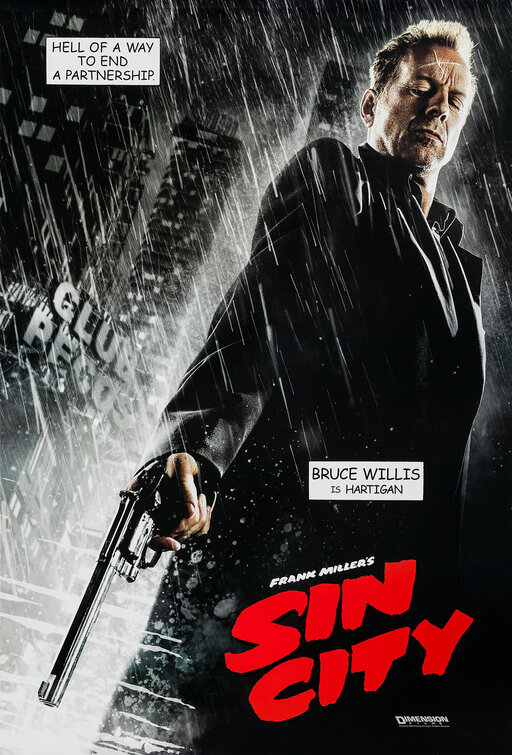
Sin City

What a waste of talent and technology.

Sin City comes onscreen as initially striking and innovative, but soon turns redundant and anti-human and, worst of all, boring. How many impalings, decapitations, severed limbs, and newfound, blood-spurting orifices are we supposed to suffer before we notice that, amidst all the incredulous plot lines, bared breasts, and sometimes admittedly amazing cinematic flourishes, stunning mediocrity has taken over? Unfortunately, like the movie’s many victims, despite being shot again and again and again, the movie just keeps on going.

Directors Robert Rodriguez, Frank Miller, and “special guest director” Quentin Tarantino, proven talents one and all, have effectively transferred Miller’s Sin City comic book to the screen but why? In having done so, the filmmakers have accomplished the cinematic equivalent of “recreating” the Eiffel Tower and planting it in Las Vegas.

“Wow” soon gives way to “So?”

Discos Matador: Intended Play 2007

The next time you’re in a, as someone (I remember not) put it, “lifestyleâ€Â store (the Ikea/Urban Outfitters lifestyle, not the Dollar General lifestyle), be sure to pick up a free copy of Discos Matador: Intended Play 2007. This superstar Matador sampler features fantastic tracks by, amongst others, The Ponys, Chavez, Love of Diagrams, Dead Meadow, Shearwater, and……….and……..and………and……..

EARLES AND JENSEN!!!!

That’s right!! Earles and Jensen representin’ with “Attitudes: A Bar With a Bunch of Dumbasses Hanging Outâ€Â and “Introducing Bleachy: Poised to Sweep the Nation.â€Â

Las Migas de Austin, Part 1

I’m grabbing a moment before I have to head in to the Austin Convention Center to interview Joe Boyd to jot down some of the stuff that’s happened so far on this trip.

***

Paris was okay, although the restaurant I ate at wasn’t worth noting (although it was inexpensive and not bad). The hotel was convenient to the Gare Montparnasse, which is where the buses to the airport leave from, and it occurred to me that Montparnasse is worth a walk when I have time. There was a nearby bar called Le Chien Qui Fume, whose neon smoking dog I’d have liked to get a picture of, although whether or not I have the skills to do this is quite another question.

I saw a number of election posters for Segolene Royale, the Socialist candidate (and, potentially, France’s first woman president, although her chances don’t look too good a the moment) with the slogan “A fairer France is a stronger France,” and I mused that this is a slogan both stirring and, uh, empty. Think about it: what on earth does it meant?

The bus to the airport has a video loop it plays, presumably to distract you from the not-so-inspiring scenery after you leave the city limits, and, as on the other trips I’ve taken on it recently, there was a longish public service announcement about pedophilic sex tourism. A good cause, of course, but a strange thing to see over and over, the litany of how many years in foreign jails various men have gotten. Do a significant number of Air France’s passengers to Charles de Gaulle Airport have sexual predation in mind at their destinations? That seemed to be the message.

Spotted on the way out of town, another Parisian eatery we won’t be patronizing: Cheaper Food Sandwiches.

***

I haven’t seen much music yet here, mostly because I’ve wanted to re-read Joe Boyd’s book White Bicycles to prepare for this afternoon’s interview. Jon Hardy (who was turned down yet again for a showcase here this year) recommended I see some of his friends from St. Louis who’d moved to New York, a band called the White Rabbits, and it was a good tip. They feature a very intense piano-playing guy, a more serene guitarist, and three other guys who move back and forth among bass, keyboards, percussion, and three drum sets. I didn’t catch enough lyrics to see if the songwriting’s there, and there’s a bit of sameness to the material which ought to even out when they write more songs. I’d be very interested to see them in a year.

Last night, of course, there was no choice: I had to at least try to get into the Stax show at Antone’s. Although the line went around the block, by some miracle I got in, and at long last got to see Booker T and the MGs, who are probably the greatest band-as-band America has produced. I mean this in kind of a jazz sense: the way the four original members, Booker T. Jones, Donald “Duck” Dunn, Steve Cropper, and Al Jackson, Jr. (who was murdered years ago: his place was taken by one of his cousins)(and yes, I know Lewis Steinberg was the original bassist), interacted almost telepathically and could raise material as bathetic as “More” and “Summertime” to astonishing heights. Forty years later, Cropper’s let the guitar-hero thing go a little bit to his head (Steve! It was all about the minimalism of your playing!), Booker seems less invested in the results, and Dunn is still the greatest bass player around, but hey, what do you want after all this time? An hour of Booker T music was something worth waiting for.

William Bell has still got it, too, and his snazzy pinstripe suit, dark sunglasses, and soul-man show was way too brief. Hunger got me out of the building during Eddie Floyd’s set. I know he’s not as young as he once was, but this “clap your hands” schtick gets old fast. And I’d seen what I’d come for, and was glad.

* * *

And I was hungry. I’ve gotten some good food here, and will probably do a full post on it later, but so far the big discovery was just a couple blocks from my hotel. My friend Scoop, whom I hadn’t seen in eons, has moved here, and he came in from his Rancho Deluxe in Bastrop County to have lunch with me. We headed for the Tâm Deli, the superb Vietnamese place Jean Caffeine turned me on to last year, only to find it closed Tuesdays, so we decided just to cruise until we found a taqueria. Buried in a strip-mini-mall, bundled with a convenience store, an auto insurance agency, and a pool hall, was Jefe’s, which I picked because they also run a taco truck, which was parked out front. We had tacos al pastor, which is marinated pork, and the order came with two squeeze bottles of salsa, one kind of brick colored, the other a pale green. Both were astonishing, the red having citrus undertones and hellfire overtones, the green subtly fiery with a wonderful herb combination. Four tacos, $4.99. I’m going back.

BRAIN-ERASING DUB FOR THE UNINITIATED

I used to listen to a lot of reggae and dub at the end of its golden era in the early 1980s, via college radio shows like Spliff Skankin’s on KFJC (great nom de plume, Spliff!) and Doug Wendt’s commercial show “Midnight Dreadâ€Â on a commercial San Francisco station called “The Quakeâ€Â. I always took to the dub stuff the most – the sinewy, echo-laden headcleaners from the likes of the Twinkle Brothers and King Tubby – but I got way deeper into obscure rock music and dropped all reggae & dub when I headed off to Bob Marley University, aka UC-Santa Barbara. It took probably 15 years before I was ready to take up the flag again around 1999, and when I did, it was dub only for the most part – to this day I have an aversion to most (not all) vocal reggae post-1970 or so.

Oddly enough, it was two chapters in an out-of-print book called “The Secret History of Rockâ€Â that got me going again; the chapters were on Tubby and Lee “Scratchâ€Â Perry, and they totally got my interest piqued. A friend then bought me AUGUSTUS PABLO’s “King Tubbys Meets Rockers Uptownâ€Â and that was all she wrote. For 8 years I have been a dub collector, I guess you’d say, if collecting means amassing a library of CD-Rs burned from others & from Soulseek, and CDs actually purchased with real cash money at great dub-laden stores like Streetlight Records in Santa Cruz, CA. A lot of my pals think that dub is kinda lame, or reeks of the reggae that they learned to loathe, and I guess I understand. I’ve been there. Yet the form, which to my ears truly existed in its top guise from about 1972 to 1982 (or thereabouts), is as wild, wacked and unpredictable as many of the rock bands we frequently revere. I’m going to post what I could very legitimately argue are 3 of the top dubs of all time. If you’re newly interested in the genre, I hope this is a portal to another dimension for ya. If you’re an old dub hand, well, then you probably have these already, but it can’t hurt to listen to them again right now at top volume, right?

Download AUGUSTUS PABLO – “King Tubby Meets Rockers Uptownâ€Â (buy the CD here)
Download GLEN BROWN & KING TUBBY – “Version 78 Styleâ€Â (buy the CD here)
Download IMPACT ALL-STARS – “Extraordinary Versionâ€Â (buy the CD here)