I just read that Claude Luter passed away. F…


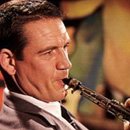
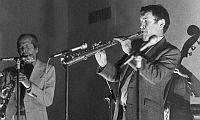
I just read that Claude Luter passed away. For those who know the book I co-edited for Rizzoli “Manual of Saint-Germain-des-Prés” by Boris Vian, his name comes up often. One of the key figures in the whole Paris post-war generation – he is probably the key figure to bring New Orleans jazz to that great city and culture.

Sadly not that much information on him in English, but I imagine him to be a fantastic personality – especially anyone who was close friends with Boris Vian. If I am not correct he played regular shows at A club till very recently. Luter was 83 years old and forever young. TamTam salutes you!

John Phillips “John The Wolfking of L.A.” CD (Varese Sarabande)

A lot of reviewers are focusing on Bob Dylan’s aping of Phillips’ cover pose and costume on the front of Desire, but the most interesting things about Wolfking –and there are plenty–are in the grooves. This storied 1969 solo disk from the ravaged ex-Papa proves that not just symbolist poets make their best work when systematically deranging souls and senses. (Of course, Rimbaud didn’t surround himself with ace players from the Wrecking Crew and Elvis’ band, nor with the Blossoms on backing vox.) Wolfking is an eclectic, ambitious and playful romp through scenes of Hollywood and Malibu excess and redemption, exquisitely sung and arranged. Phillips’ style fuses country, pop, scat, gospel and soul in a very personal and appealing way. Eight strong bonus tracks easily turns the disk into a shoulda-been double, including the tender "Lady Genevieve" which negates some of the emotional ugliness of "Let It Bleed, Genevieve" from the original album, and ending with the superior single version of "Mississippi."

(Buy from Amazon. See also Brian Doherty’s review of the album from the Lost in the Grooves book.) 

Thanks, Watson!

I saw the recent blog about Johnny Guitar Watson and wanted to add my two cents about this brilliant guitarist by reviewing a different compilation from a year ago. Regardless of when you discover “Guitar” – it will always be a scintillating funktastic experience.

Johnny Guitar Watson – The Funk Anthology
Shout Factory
Right off the bat I have to say these are the funkiest two CDs I have heard in a long time. CDs so funky I will put up a dare to you: I will wager my unassailable credentials as a hipper-than-hip music journalist, my various lifetime achievement awards for snarky critique-writing, my curmudgeon’s license, and my title as Funk Overlord (yes, Funk Overlord – I won it fair and square from the guys in Black Merda in a card game!) if you can find two CDs funkier then this. Now, James Brown doesn’t count, but anyone else is fair game.

Though Watson originally started his career and gained his first fame as a bluesman, Watson was a master at continually re-inventing himself throughout his career and by the end of his life was known more for being a George Clinton-esque funkmeister than for his blues. He first started in the ’50’s as a piano player and then switched to guitar, which is where he first began getting noticed. In this way he was a lot like Ike Turner, who also first strarted working as a piano player before picking up the guitar. Like Turner, Watson was an inventive bandleader who came up with many innovative arrangements and skillful gimmicks to set himself apart from the pack. While not pursuing the business angles Turner did to get noticed, Watson was able to market himself as a viable solo artist due to his excellent singing voice, which led to many opportunities never open to Turner. Where Turner had to either find his Tina or record instrumentals, Watson was able to take advantage of many styles, though paradoxically, it took Watson many more years to become a household name than it did Turner.

He eventually did get his due, though. Starting with his signing to the Dick James Music Group in the early ’70’s, Watson was set to take his road-tested funk persona to a new level. He had long since went through his early blues phase, a soul phase in the ’60’s, and several other R&B-based experiments which kept him on the verge of breaking through in a big way but had not quite clicked with the public. Luckily for Watson, he was always ahead of the curve in terms of his ability to judge what would be popular next, what the public was looking for. His problem was he had just not been in the right place or situation to capitalize on it. His extraordinary musicianship kept him in the game as well. Capable of playing many instruments, Watson was always an innovator with sound just as much as with vision. One of the first to experiment with synthesizers, Watson was dreaming up funky applications for them years before most of the artists people readily assume as being the leaders of the new technology. For example, Watson was using the talkbox years before Peter Frampton and funkateer Roger made their names with the device.

This 2 CD set covers the best of Watson’s time with the Dick James Music Group and also includes cuts from his last recording, Bow Wow, which was released in 1994. Of course, most of the set leans towards Watson’s work from the mid-70’s to about 1982 – which was the last time he recorded before his comeback Bow Wow so the set pretty much covers his latter and most fertile period right up until his death. There are a healthy four cuts each from the six albums he released – and one can definitely hear the progression as Watson’s funk style became more and more assured and confident with each subsequent release. While Bow Wow is nothing more than a desperate, lackluster attept by Watson to show he could still funk with the best of them, the album does have a few moments on it that a Watson fan (or any stone funk fan for that matter) would like and most of those are included on this CD set.

For those of you who think Sly Stone and George Clinton’s various projects were the only funky things going on in the ’70’s, this set is going to shock the hell out of you. Music just can’t get any funkier than this. Pick this up now!

So that’s it. Get you some Johnny Guitar Watson as soon as you can ’cause you don’t want to live without the funk for very long!

The Music Nerd knows…..about Da Fonk!

The Abominable Snowman

While it certainly wouldn’t qualify for Paul Schrader’s canon of great films (or anybody else’s, for that matter, including mine), whenever I happen across this 1957 movie (sometimes calling itself The Abominable Snowman of the Himalayas) when it airs on Turner Classic Movies, I inevitably watch until the end. Director Val Guest treats screenwriter Nigel Kneale’s intelligent script so matter-of-factly that parts of the movie achieve a documentary feel (helped along, admittedly, by the wealth of stock footage of the Himalayan mountain range and avalanches). 

I remember staying up late one night to watch this, for the first time, as a child, and being absolutely mesmerized by Peter Cushing’s long-awaited face-to-face encounter with the Yeti. The effect remains the same for me today: menace mixing with mystery as the unbelievably tall beings step from the shadow into the light, finally revealing the eyes of the Yeti. Those age-old eyes. 

Ox Populi

It’s true:
The one and only Chief Beatle would’ve actually hit 66 today. 

Ugh.

But lest we EVER forget
that other great big, loud, solid (yet stolid) John

who once made those Sixties swing,

who too was born on 9 October,

and Who is as well, most unfortunately indeed,
nowhere around anyway anywhere anyhow anymore.

And just when we could use him
the very very most…..
 

The Rules of the Game

“You see, in this world there is one awful thing, and that is that everyone has his reasons.”

I’ve known that quote well for many years, thanks to the writings of Paul Nelson (who referenced it often), just as I’ve known that the man responsible for originally uttering those words was Jean Renoir. But until last week, when I watched his fine film The Rules of the Game for the first time in over twenty years, I didn’t know (or I’d forgotten) that the quote emanated therein. Spoken by the pivotal character Octave, played by Renoir himself, hearing the words spoken aloud, in French, was a surprise and a revelation.

(In writing a biography of Paul Nelson and collecting his best writings into book form, and trying to understand how someone so talented and so loved came to an end that few of his old friends could comprehend living a life that was solitary at best, lonely at worst, while no longer writing for publication I’ve been tempted to rely on Renoir’s words to explain and excuse what happened. Thus far that strikes me as too easy; but then, I’ve more than once used Renoir’s quote to explain my own actions.)

In the September/October 2006 issue of Film Comment, director Paul Schrader writes an ambitious, lengthy (the longest article the magazine has published in its 42 years), erudite, and sometimes impenetrable piece entitled “The Film Canon” (the introduction to which may currently be found online). Supposedly sans favoritism and “taste, personal and popular,” based on “those movies that artistically defined film history,” he cites The Rules of the Game as the number one greatest film of all time.

According to Schrader: “For me the artist without whom there could not be a film canon is Jean Renoir, and the film without which a canon is inconceivable is The Rules of the Game.”

It is no doubt a great film: funny and poignant and heartbreaking and, ultimately, very moral (thus satisfying Schrader’s dictum that “no work that fails to strike moral chords can be canonical”). But even if it were not, if it were only a so-so movie that happened to contain Renoir’s memorable quote, which spoke to me last week as if it were Paul Nelson trying to help me understand, there’d be a place in my heart for The Rules of the Game.

For us Americans, Raymond Queneau’s name comes …

For us Americans, Raymond Queneau’s name comes up between other writers. Georges Perec, Georges Bataille, Andre Breton, Michel Leiris, and so forth. He is also for the causal reader a hard writer to get a clear picture of his writing. In an essence he was the shadow writer of the 20th Century.

The first book I read of Queneau’s was “Exercises in Style,â€Â which in one way serves as a writing manual while at the same time it is a witty a charming piece of fiction. The thing is with Queneau’s writing is that you get a duality – that I think is important in his work.

One of his masterpieces (I tend to like everything by an author I admire) is “Hundred Thousand Billion Poems.â€Â It is a work that is never in place, it consistently moves. I think poetry should be written in air instead on rock. Or a book that looks like one of those changeable head/bodies/legs books.

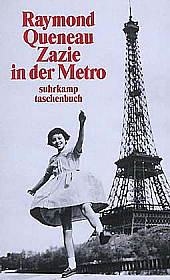
Queneau’s most beloved book is probably “Zazie n the Metro.â€Â Written n colloquial French instead of academic French, Zazie was considered to be a work from a rebel. But a charming rebel. The book is charming with regards of Zazie investigating Paris via the Metro system. A great city novel.

For the Boris Vian obsessive I strongly recommend a book Queneau wrote under another name Sally Mara. Like Vian’s ‘Vernon Sullivan’ Queneau wrote a noir thriller called “We Always Treat Women Too Well.â€Â In many ways it is the sister or brother to Vian/Sullivan’s “I Spit on Your Graves.

Fried Decadence

“Let me tell you about the very rich,” F. Scott Fitzgerald wrote. “They are different from you and me. They possess and enjoy early, and it does something to them, makes them soft where we are hard, and cynical where we are trustful, in a way that, unless you were born rich, it is very difficult to understand. They think, deep in their hearts, that they are better than we are because we had to discover the compensations and refuges of life for ourselves. Even when they enter deep into our world or sink below us, they still think that they are better than we are. They are different.” 

The very rich are also different because they can afford to spend $4.00 for a regular order of fries at Pommes Frites in Manhattan’s East Village. Six and a quarter will get you an unbelievably large helping and, if you’re hosting a small party, you can order a double for $7.50.


Now, I’m not very rich (or even rich), but I partake of Pommes Frites where the fries aren’t French, they’re Belgian whenever possible. Two nights ago, I circled the block numerous times, each time more desperately, in search of a parking space. Parking, alas, is the only thing missing from Pommes Frites’ menu. Last night, however, thanks to [info]nydeborah graciously offering to remain in the double-parked car while I hurried into the restaurant as deep as a sidewalk is long, and about as wide, too I got my fry fix. 

About the menu: fries. That’s it. Just fries and more than two dozen gourmet dipping sauces. For a boy from Salt Lake City, the home of fry sauce, this is heaven on earth. I recommend the roasted garlic mayo. 

Like all things truly decadent, the desire to gorge yourself with these long, lithe pieces of potato is quickly satisfied; but that doesn’t stop you from wanting more, eating more. And by the time you’re finished, a slightly dirty feeling supplants the one of satisfaction, and you drop your head into your greasy hands, stomach so full it aches. But, ending this post with a quote by the same author with whom it began, “Sometimes it is harder to deprive oneself of a pain than of a pleasure.”